
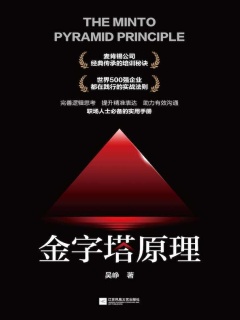
《金字塔原理》一书由麦肯锡前咨询顾问巴巴拉・明托所著(我曾反复研读),首次系统揭示了清晰思考、有效表达与高效解决问题的底层逻辑体系。不过,其文风更偏向欧美式的直白表述,对部分国内读者而言可能稍显疏离。中国作者吴峥的这本同名著作则不然 —— 它并非对明托经典的简单转述,而是一部立足于中国商业与组织语境、将经典方法论进行本土化重构与深度诠释的实践指南。从某种程度上看,它不仅是前者的续写,还展开了更深入的剖析与更广泛的本土应用。 在中国,许多专家的影响力建立在市场与实践检验之上,而非完全依赖传统学术资历。因此,吴峥的这本书写得更 “接地气”,对大多数国内读者来说阅读体验也更为顺畅 —— 全书在继承原版核心框架的同时,融入了大量本土案例与管理场景,使其更贴近中国读者在复杂组织环境中的真实需求。 本书最突出的价值在于其 “知行合一” 的导向。作者不仅阐释了金字塔结构的逻辑内核 —— 结论先行、以上统下、归类分组、逻辑递进,更着力探讨了这一思维工具在中国式沟通、汇报与决策场景中的具体应用。书中对 “如何向上级清晰汇报”“如何在会议中有效陈述观点”“如何将复杂问题分解为可执行的模块” 等典型情境的剖析,体现出对中国组织文化与沟通习惯的深刻洞察,从而将抽象的原理转化为可操作的工具,显著降低了方法论的应用门槛。 在我看来,本书最具启发的部分,在于将结构化思维与系统性问题解决相结合。书中提出的 “从纷繁现象中构建初步假设,再以逻辑树进行验证” 的思路,为管理决策提供了既严谨又高效的思维路径。 在信息过载、决策压力剧增的当代商业环境中,清晰、精准、有说服力的表达已成为一项核心职业能力。本书不仅是一本关于写作与表达的技术手册,更是一部培养逻辑思维、提升认知效率、优化决策质量的实用指南。对于任何希望在中国商业环境中提升专业沟通与问题解决能力的管理者来说,这本书都是一份不可或缺的思维装备,而且值得一读再读。 The Pyramid Principlewas authored by Barbara Minto, a former McKinsey consultant (a work I have studied repeatedly). It systematically reveals, for the first time, the underlying logical framework for clear thinking, effective expression, and efficient problem-solving. However, its writing style leans toward a Western straightforwardness, which may feel somewhat distant to some domestic readers. The book of the same title by Chinese author Wu Zheng is different—it is not a simple retelling of Minto’s classic but a practical guide rooted in the Chinese business and organizational context, reconstructing and deeply interpreting this classic methodology for local application. To some extent, it is not only a continuation of the former but also offers deeper analysis and broader localized application. In China, the influence of many experts is built on market and practical validation rather than solely on traditional academic credentials. Therefore, Wu Zheng’s book is more “down-to-earth,” offering a smoother reading experience for most domestic readers—while inheriting the core framework of the original, it incorporates a wealth of local case studies and management scenarios, making it more aligned with the real needs of Chinese readers in complex organizational environments. The most outstanding value of this book lies in its "integration of knowledge and action" approach. The author not only explains the logical core of the pyramid structure—conclusion first, top-down organization, grouping, and logical progression—but also focuses on the specific application of this thinking tool in Chinese-style communication, reporting, and decision-making scenarios. The analysis of typical situations such as “how to report clearly to superiors,” “how to effectively present viewpoints in meetings,” and “how to break down complex problems into actionable modules” demonstrates a deep insight into Chinese organizational culture and communication habits. This transforms abstract principles into actionable tools, significantly lowering the barrier to applying the methodology. In my view, the most enlightening aspect of the book lies in combining structured thinking with systematic problem-solving. The approach proposed in the book—“constructing preliminary hypotheses from complex phenomena and then verifying them with logic trees”—provides a rigorous yet efficient thinking path for management decision-making. In today’s business environment, characterized by information overload and increasing decision-making pressure, clear, precise, and persuasive expression has become a core professional competency. This book is not merely a technical manual on writing and expression but a practical guide to cultivating logical thinking, enhancing cognitive efficiency, and optimizing decision-making quality. For any manager seeking to improve their professional communication and problem-solving abilities in the Chinese business context, this book is an indispensable thinking tool—and one worth reading again and again.