- Frank2022-11-26 编辑给这本书评了1.0
非常有趣的书名,非常有深度的逻辑思维内容,作者却以非常糟糕的问卷表格和解释方式呈现给读者。这本书还有《2》,但除了书名一样外,写作风格完全是另外一本书。建议对批判性思维感兴趣的读者阅读《学会提问》。 本书不建议阅读,不建议购买。
转发转发同时评论快速转发评论2分享「微信」扫码分享操盘手~那睿2021-05-08给这本书评了5.0反者道之动,弱者道之用预先取之,必先予之;将欲夺之,必固与之
转发转发同时评论快速转发评论2分享「微信」扫码分享不再沉沦01-22给这本书评了4.0读后本书的书名充满挑衅意味。它并非传统意义上的哲学著作,而是通过一系列逻辑谜题、观念测试和思维实验,挑战读者自以为是的认知,并用严密的推理将其一一拆解。其核心设计在于,将抽象的批判性思维转化为可体验、可测试的具体场景。它不灌输理论,而是设置思维陷阱:当我们自信地回答那些关于道德、信仰或社会议题的问卷时,随后的逻辑分析往往会揭示答案之间隐藏的自相矛盾。这种亲身体验远比任何说教都更震撼 —— 它让我们亲眼看见自己思维中的断层与偏见。本书像一位冷静的认知侦探,逐一检视我们赖以建立信念的脆弱基石:从 “确认偏误” 到 “情感启发式”,从 “信念固着” 到 “叙事谬误”。由此揭示了一个残醋的真相:人类本质上是 “认知的吝啬鬼”。我们依赖直觉、惯于简化、容易被框架效应左右,却总以为自己的判断源于理性。对我而言,最大的冲击并非认识到自己会犯错,而是意识到我常常无法即时察觉自己正在犯错。这种对 “元无知” 的揭露,迫使我不得不承认:许多深信不疑的观点,或许只是未被挑战的习惯;许多义正辞严的立场,可能建立在逻辑的流沙之上。它提醒我要保持一种智识上的谦逊 —— 在坚定之前先审视,在批判他人之前先反思自身。最后需指出,书中的测验与案例多基于西方社会文化背景下约定俗成的认知框架,对东方读者可能在理解上构成一定的挑战或隔阂,这是在阅读时需要留意的一点。The provocative title of the book immediately captures attention. It is not a philosophical work in the traditional sense, but rather employs a series of logic puzzles, concept tests, and thought experiments to challenge the reader's self-assured cognition, dismantling it piece by piece through rigorous reasoning. Its core design lies in transforming abstract critical thinking into concrete, experiential, and testable scenarios. Instead of imparting theory, it sets cognitive traps: when we confidently answer questionnaires on morality, faith, or social issues, subsequent logical analysis often reveals hidden contradictions within those answers. This firsthand experience is far more impactful than any lecture—it allows us to witness the fractures and biases in our own thinking firsthand.The book acts like a calm cognitive detective, examining one by one the fragile foundations upon which we build our beliefs: from "confirmation bias" and "affect heuristic" to "belief perseverance" and "narrative fallacy." This reveals a sobering truth: humans are essentially "cognitive misers." We rely on intuition, tend to oversimplify, are easily swayed by framing effects, and yet we consistently believe our judgments stem from rationality.For me, the greatest impact was not merely realizing that I make mistakes, but recognizing that I often cannot immediately detect when I am making them. This exposure of "meta-ignorance" forces me to admit that many deeply held convictions may be nothing more than unchallenged habits, and many righteously defended positions might be built on logical quicksand. It reminds me to maintain intellectual humility—to examine before becoming firm, and to reflect on myself before criticizing others.Finally, it should be noted that the tests and cases in the book are largely based on cognitive frameworks commonly accepted within Western sociocultural contexts. This may pose certain challenges or create a sense of distance for readers from Eastern backgrounds, a point worth bearing in mind while reading.
转发转发同时评论快速转发评论赞分享「微信」扫码分享 得到用户2025-09-24给这本书评了4.0本书感悟
1. 一个人的固执中藏着低水平认知,认知不够,会更固执。2. 从哲学来讲,你知道的一切都不重要,从事实来讲你知道的一切还是很重要的!3. 大千世界,知识无穷无尽,尽自己所能获取更多知识。4. 矛盾无处不在,自己本身就是一个矛盾体,果真不能看他说了什么应该看他做了什么。2025 年 9 月 24 日
转发转发同时评论快速转发评论赞分享「微信」扫码分享 行云流水🐬2023-03-29给这本书评了3.0
很多时候我们自以为很坚持的东西,其实是虚妄,因为我们丝毫没有注意到自己坚持的是些彼此矛盾的东西。明明不懂哲学不喜欢测试,还是浪费时间滑到了最后,我比我以为的还浪费时间。
转发转发同时评论快速转发评论赞分享「微信」扫码分享

 电子书
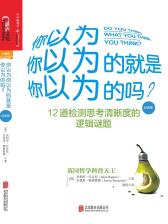
电子书你以为你以为的就是你以为的吗?
《你以为你以为的就是你以为的吗》中,作者精心设计了12道检测思考清晰度的逻辑谜题,涵盖哲学、逻辑推理、信仰、思想一致性、禁忌底线、道德标准、艺术、身心灵、自由、终极逻辑常识等多个有趣话题。读者可以通过12道逻辑谜题检测思考的清晰度,快速提高思考力,抓住别人的思维漏洞!


